

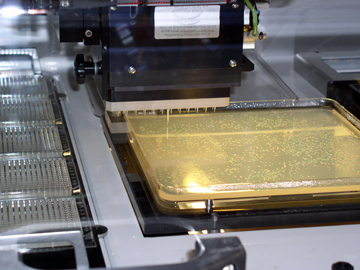
MGEL's "Dixie Pix" robot hard at work
DNA LIBRARIES
Overview | Libraries | Library Naming Conventions
Overview
We are currently involved in the production of bacterial artificial chromosome (BAC) libraries and Cot-filtered libraries (see Cot Filtration & CBCS) from a variety of species. The BAC and Cot-filtered libraries are being used in physical mapping, gene isolation, genome sequencing, and various forms of genome analysis conducted in our lab and the labs of our collaborators. Below is a list of libraries that we have constructed, have helped to construct, or are in the process of constructing. All libraries constructed as part of federal grants are available to any interested parties on a cost-recovery basis. In some instances, MGEL does not distribute the DNA resources (e.g., libraries, clones, macroarrays, etc.) it generates but rather has such services performed by organizations that specialize in molecular resource management and distribution (e.g., the Clemson University Genomics Institute and the Plant Genome Mapping Laboratory). To learn more about a particular library (including vector, host, insert size, clone number, etc.) and information on its distributor, click on a link under the heading "Library Name." See the Library Naming Conventions section below to learn how library names are developed. Contact Daniel Peterson for additional details.
Libraries
| Library Name | Library Type (see below) |
Species & 'Cultivar, Strain, or Individual' | Common name | ||
| PT_7Ba | B | Pinus taeda '7-56' | Loblolly pine | ||
| TDD_Ba | B | Taxodium distichum | Bald cypress | ||
| CP_EBa | B | Crocodylus porosus 'Errol' | Saltwater crocodile | ||
| RR_UBa | B | Rotylenchulus reniformis | Reniform nematode | ||
| ZM_MP313EBa * | B | Zea mays 'MP313E' | Maize | ||
| GR__Ba | B | Gossypium raimondii | D-genome cotton | ||
| GH_MBb | B | Gossypium hirsutum 'Maxxa' | Upland cotton | ||
| VV_SBa | B | Vitis vinifera 'Syrah' | Grape | ||
| SB_BSa | S | Sorghum bicolor 'BTx623' | Grain sorghum | ||
| SB_BMa | M | Sorghum bicolor 'BTx623' | Grain sorghum | ||
| SB_BMb | M | Sorghum bicolor 'BTx623' | Grain sorghum | ||
| SB_BHa | H | Sorghum bicolor 'BTx623' | Grain sorghum | ||
| TA_CTa | T | Triticum aestivum 'Chinese Spring' | Bread wheat |
*Library assigned name prior to adoption of standardized naming conventions
Library Naming Conventions
DNA libraries produced at MGEL are named using the conventions utilized by the Clemson University Genomics Institute and the Arizona Genomics Institute. Each library name consists of six identification fields. Below is an example of a file name broken into its six fields and a legend explaining the meaning and limits of each field.
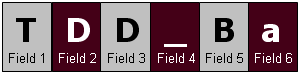
Field 1 - First letter of the genus of the organism from which the library was derived. In the example, the T stands for Taxodium.
Field 2 - First letter of the species name of the organism from which the library was derived. In the example, the D stands for distichum.
Field 3 - First letter of the subspecies from which the library was derived. If a subspecies name is not known or not applicable, an underscore, _, is used to show that the subspecies field is empty. In the example above, the D stands for subspecies distichum.
Field 4 - First letter or number of the cultivar/genotype from which the library was derived. As with the Field 3, an underscore can be used to indicate the lack of a known cultivar or genotype (as shown above).
Field 5 - A one letter abbreviation for the means by which the library was constructed. At MGEL, we currently have libraries with the following Field 5 designations:
- B = bacterial artificial chromosome or BAC. BACs are modified E. coli F plasmids capable of carrying inserts up to ca. 400 kb. They are a staple of physical mapping and genome sequencing research.
- S = single/low-copy, Cot-filtered. An 'S' library is prepared from the slowest, mathematically-discernible kinetic component of a genome as defined via standard Cot analysis.
- M = moderately repetitive, Cot-filtered. An 'M' library is prepared from the middle component of a three component genome as delineated by standard Cot analysis.
- H = highly repetitive, Cot-filtered; An 'H' library is prepared from the fastest reassociating component (excluding foldback DNA) of a three component genome as defined by standard Cot analysis.
- R = repetitive, Cot-filtered; An 'R' library is prepared from the fastest reassociating component (excluding foldback DNA) of a two component genome as determined by standard Cot analysis OR a library prepared from the combined H and M components of a three component genome.
- U = ultra-rapidly reassociating. A 'U' library is prepared from the DNA that binds to a HAP column (in 0.12 M sodium phosphate buffer) at a Cot value of virtually zero. Such ultra-rapidly reassociating (or foldback DNA as it is often called) is presumably due to intramolecular base pairing, although recent studies suggest that this explanation may be too simplistic.
- T = theoretical single-copy, Cot-filtered. A 'T' library is prepared from any DNA that remains single-stranded at 0.1*theoretical Cot value for single-copy DNA as predicted from genome size (see Peterson 2005 for further explanation).
- G = genomic (random) DNA cloned into a standard "small insert" plasmid vector (e.g., PUC or pGEM vector).
Field 6 - A one lowercase letter "wildcard" that can be used to differentiate similar libraries constructed from the same organism, e.g., a Taxodium distichum BAC library produced using a partial HindIII digestion might be assigned the wildcard "a" while a Taxodium distichum BAC library produced using a partial BstyI digestion might be assigned the wildcard "b."
Other Areas of Expertise: Bioinformatics | Cot Analysis | Cot Filtration & CBCS | Cytogenetics